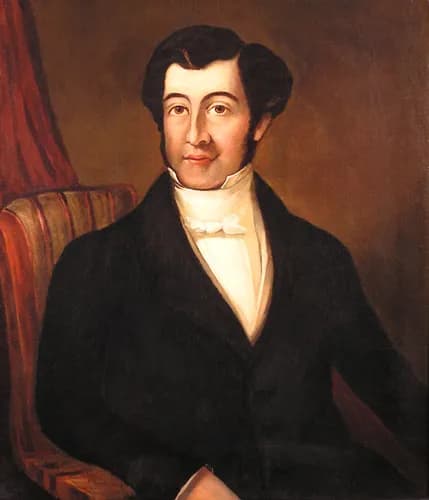
Intro
Joseph Bramah was born in Stainborough, then a rural parish on the edge of modern Barnsley, and went on to patent the flushing water closet in 1778. His inventions, from the Bramah lock to the hydraulic press, transformed daily life and secured his place among the most prolific engineers of the Industrial Revolution.
From Stainborough to the Workshop
Born on 13 April 1748 to Joseph Bramma, a farmer, and Mary Denton, young Bramah grew up in Stainborough, then within the larger parish of Silkstone. He attended the local school before being apprenticed to a carpenter in the area. In 1774, his mother was killed in an accident on Kereforth Hill while riding pillion; the tragedy prompted him to leave Yorkshire for London. It was in the workshops of Cross Court and Denmark Street that he transformed himself from a provincial carpenter into one of Britain's most celebrated inventors.
The Water Closet Patent
While working for a Mr Allen installing water closets based on Alexander Cumming's 1775 design, Bramah identified a critical flaw: the slide valves tended to freeze in cold weather. Allen improved the mechanism by replacing the slide with a hinged flap, but it was Bramah who secured Patent No. 1177 in 1778, regarded as the foundation of the modern flush toilet. He later added a water cock in 1783, and began manufacturing the units from his Denmark Street workshop. One of his original toilets remains in working order at Osborne House on the Isle of Wight.
Beyond the Bathroom
Bramah's inventive output extended far beyond sanitation. In 1784 he patented the Bramah lock and established his company at 124 Piccadilly, which survives today as London's oldest security company and once offered 200 guineas to anyone who could pick its challenge lock. The prize went unclaimed for over half a century until Alfred Charles Hobbs opened it at the Great Exhibition in 1851 after 51 hours of effort. In 1795 he patented the hydraulic press, applying Pascal's principle in a device still known as the Bramah Press; his other patents ranged from a beer engine and fire engine to a planing machine, a bank-note printer with sequential numbering, and a quill-pen nib machine.
Barnsley Roots and Lasting Legacy
Despite building his career and factories in London, Bramah maintained strong ties to South Yorkshire. In 1783 he married Mary Lawton of Mapplewell, a village roughly three miles north of Barnsley town centre. Today, his local legacy includes a memorial in the Parish Church of All Saints at Silkstone and The Joseph Bramah pub, opened by Wetherspoon in Barnsley town centre in 2006. The Institution of Mechanical Engineers established the Joseph Bramah Fund in 1968 to commemorate his work through scholarships and an annual medal.
What Is Confirmed: Bramah was born in Stainborough, baptised on 12 May 1748, patented the water closet in 1778, and secured at least 18 patents between 1778 and 1812.
What Is Unclear: Sources disagree on his exact birth year; Wikipedia and Grace's Guide state 1748, whilst Bramah.co.uk records 1749.
